
According to Iltalehti:
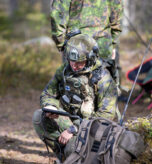
“the chairman of the Finnish Reservists’ Association, urged reservists to acquire personal protective equipment in January. According to Salminen, the equipment purchases are urgent, because it is too late when the crisis breaks out. “The most important protective equipment, i.e. helmet and vest, is the minimum number,” he said. Salminen said that you can get a helmet and a vest that avoids your condition for a thousand euros, but two thousand already get “fell good”.
For many ordinary citizens, a couple of thousand euros of equipment is a big investment – especially when you may never be able to use them. Antti Kettunen encourages those considering purchasing equipment to start with basic accessories, such as good off-road shoes, which may also be used in everyday life.”
The magnitude of shortages is astounding:
“In Finland, material has been designed and stored for the duration of the war, i.e. about 280 000 soldiers. “As a rule, the equipment is sufficient for the troops to be established,” says PV. For the entire trained reserve, i.e. about 870 000 Finns, the equipment is not in stock, but in exceptional circumstances, additional troops could be equipped with material replenishment, domestic production, international support and maintenance.”
Turns out Finland doesn’t even have the most basic equipment for the majority of its reserve. Mass conscription then provides a reserve that the Finnish Defence Forces are not even prepared to use. What exactly is the power of deterrence of a reserve one cannot possibly mobilise? Shouldn’t the priority be to arm the men already in reserve, before mass conscripting younger people? The total defence seems to actually be partial defence.
The entire story can be found here.